Quick Answer
Pick the tooth up by the crown, never the root. If it is dirty, rinse it briefly with milk or saline, then gently place it back in the socket and bite on clean gauze. If you cannot replant it, keep it in a cup of milk. Then call an emergency dentist right away. Getting seen within the hour gives the tooth its best chance.
A tooth knocked out during a game or a fall is alarming, and what you do in the next few minutes changes the outcome. The steps are simple, and a knocked-out permanent tooth can often be saved.
What Is a Knocked-Out Tooth?
A knocked-out tooth, called an avulsed tooth, has come completely out of its socket. That is different from a tooth that is loosened, pushed sideways, or chipped, though those also need prompt attention.
What decides whether it can be saved is invisible. Periodontal ligament cells coat the root surface, and they are what let the tooth reattach to bone. Keeping them alive is the whole job in the first hour.
What Should You Do Immediately?
Work through these in order:
- Pick it up by the crown. The crown is the white chewing part. Never touch the root, where the delicate cells sit.
- Rinse only if dirty. Use milk or saline for a few seconds. Do not scrub, use soap, or dry it.
- Put it back in the socket. Line it up with the neighboring teeth and press gently. This is the single best thing you can do.
- Hold it in place. Bite softly on clean gauze to keep it seated.
- If you cannot replant it, store it. Put it straight into a cup of milk. Never let it sit dry.
- Control bleeding and swelling. Gentle pressure with gauze, and a cold compress on the cheek.
- Call an emergency dentist. Say a permanent tooth has been knocked out so you are prioritized.
Emergency Checklist: What to Bring
- The tooth, replanted or in a container of milk
- Any broken tooth fragments you can find
- Photo ID and your insurance card, if you have one
- A list of your current medications
- The time the injury happened
- How it happened, especially if the head was struck
What Should You Avoid?
A few well-meant mistakes can cost the tooth. Do not:
- Handle it by the root, which damages the cells needed for reattachment.
- Scrub, brush, or wipe the root clean. A brief rinse is all it should ever get.
- Store it in tap water, which damages root cells quickly.
- Let it dry out, including wrapping it in a tissue. Dry is the worst state of all.
- Use antiseptic, alcohol, or soap, which harms the cells you are protecting.
- Wait to see if it settles. This one has a clock running.
How Long Can a Knocked-Out Tooth Be Saved?
Sooner is always better, and the key measure is dry time, meaning how long the root sits exposed to air rather than in the socket or a suitable liquid.
According to the International Association of Dental Traumatology, most of the ligament cells on the root are no longer viable after about 30 minutes of dry time, and after 60 minutes essentially none survive. That is why putting the tooth into milk immediately matters so much. Once it is in a suitable liquid, the clock slows considerably.
Research reflects this. Teeth replanted within the first hour do considerably better long term, and most teeth eventually lost had spent over an hour outside the mouth. Outcomes are never guaranteed, but the first hour is where you have the most influence.
Why Delaying Treatment Reduces the Chance of Saving It
Once the root cells dry out and die, the tooth cannot reattach normally. The body treats it as foreign material, and the root gradually breaks down through a process called resorption, or fuses to bone in a way that causes problems later.
Delay also allows the empty socket to start closing and any contamination to set in. A tooth replanted quickly may last many years, while one replanted late often fails and leads to a gap that later needs a dental implant or a bridge, a far larger undertaking than a same-day visit.
How Should You Store the Tooth?
If you cannot get the tooth back in the socket, what you put it in matters more than most people realize.
| Storage Option | Use It? | Why |
|---|---|---|
| Back in the socket | Best choice | Natural environment, keeps cells alive |
| Cold milk | Excellent | Widely available and gentle on root cells |
| Saline solution | Very good | Contact lens saline works well |
| Saliva, held in the cheek | Acceptable backup | Adults only, never for young children |
| Tap water | No | Damages root surface cells quickly |
| Dry tissue or napkin | No | Cells die fastest with no moisture |
Milk is the practical answer for most families since it is usually within reach. A clean container with a lid works fine.
What Happens at an Emergency Dental Visit?
Knowing the sequence helps take the panic out of the drive over:
- Rapid assessment. We check the tooth, socket, and gums, and ask how long it has been out.
- Digital X-rays. These show the socket, the bone, and whether other teeth were damaged.
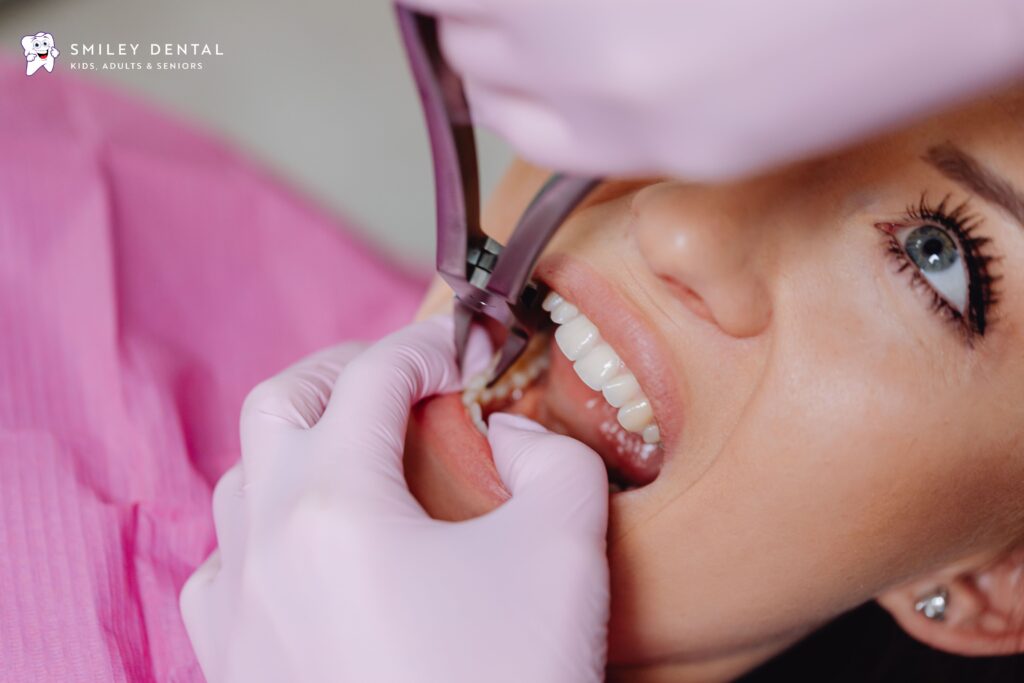
- Cleaning and replanting. The area is numbed, the socket cleaned, and the tooth repositioned.
- Splinting. A flexible splint holds the tooth to the neighboring teeth while the ligament heals, typically for around two weeks.
- Follow-up care. Root canal treatment is often needed within two weeks for a fully formed tooth, with check-ups over the following months.
Injuries to the lips, gums, or cheeks are treated at the same visit. Read more on our tooth trauma and same-day emergency care pages.
What If a Baby Tooth Is Knocked Out?
This is the important exception, and it surprises most parents.
Do not put a knocked-out baby tooth back in. Replanting one can damage the permanent tooth developing above it, a worse outcome than the gap. Keep your child calm, control bleeding with gentle pressure on clean gauze, and call us. We will check the area and confirm the permanent tooth is unharmed. Our children’s dentistry team handles these visits gently.
If you are unsure whether it was a baby tooth or a permanent one, bring it in milk and let us decide. Never guess and replant.
How Can You Prevent Dental Injuries?
Most knocked-out teeth come from sports and falls:
- Wear a mouthguard for any contact or collision sport
- Choose a custom-fitted guard over a boil-and-bite
- Wear a helmet with a face guard where the sport calls for one
- Use seat belts and properly fitted car seats every trip
- Keep walkways and stairs clear and well lit
- Do not use teeth to open packaging or bottles
- Avoid chewing ice and other very hard objects
Regular dental exams and preventive care help too, since decayed teeth dislodge more easily than healthy ones.
When Should You Seek Emergency Dental Care?
A knocked-out permanent tooth always counts as an emergency, as do several related injuries.
Signs You Need Same-Day Emergency Dental Care
Call right away for a partly or fully knocked-out tooth, a cracked or fractured tooth, a chipped or broken tooth, damaged gums, lips, cheeks, or tongue, a lost filling or crown, or severe and lasting tooth pain. Go to the emergency room first if there was a loss of consciousness, confusion, a suspected broken jaw, or bleeding that will not stop.
Why Choose Smiley Dental Boston?
Our Roslindale dental office accepts same-day dental emergencies, and in most cases without a prior appointment. When a tooth has been knocked out, that speed is the whole point.
- An experienced team, trained at Harvard, Boston University, NYU, the University of Michigan, and other respected schools.
- Emergency hotline at 857-888-8000 for guidance while you travel.
- Care for all ages, with a calm approach that helps after a frightening accident.
- Digital diagnostics for fast assessment of the tooth and bone.
- A convenient location at 950 American Legion Hwy, serving Roslindale, Mattapan, Hyde Park, Dorchester, Jamaica Plain, and West Roxbury.
Our team speaks English, Spanish, Portuguese, and Haitian Creole, and we have been recognized among America’s Best dentists. Reach us through our contact page.
The Bottom Line
A knocked-out tooth is one of the few dental problems where minutes count. Handle it by the crown, keep it moist in the socket or in milk, avoid water and drying, and get to a dentist quickly. Those four things carry almost all the weight.
Acting fast will not guarantee the tooth survives, but waiting almost always reduces the chances. If it has just happened, treat it as urgent and call now.
Tooth knocked out? Call us now.
Smiley Dental Boston accepts same-day dental emergencies. Call 857-888-8000 and tell us a tooth has been knocked out, or request an emergency appointment. Find us at 950 American Legion Hwy, Roslindale. Keep the tooth in milk on your way.
Frequently Asked Questions
Often, yes, especially if replanted quickly. Handling it by the crown, keeping it moist in milk, and reaching a dentist within the hour give the best chance. No dentist can guarantee the result, but fast action matters.
Tap water damages the delicate cells on the root surface, and those cells are what let the tooth reattach to bone. If it is dirty, rinse briefly with milk or saline instead.
That is common and not a failure. Put it straight into cold milk and head to the dentist. The important thing is that the root never dries out on the way.
Dry time is what matters most. After roughly 30 minutes of dry exposure many root cells are lost, and after an hour most are gone. Milk pauses that decline, so store the tooth properly and come in as soon as you can.
No. Replanting a baby tooth can harm the permanent tooth developing above it. Control the bleeding, keep your child calm, and call us so we can check the area and confirm nothing else was damaged.
Usually, for a fully developed adult tooth. The nerve rarely survives being detached, so root canal treatment is typically started within two weeks of replanting.
Bring every fragment you can find, kept moist alongside the tooth. Pieces can sometimes be bonded back on, and they help the dentist understand the injury.
Yes. We see children for dental emergencies and work to keep the visit calm. Call ahead so we can prepare for your arrival and guide you on the way.