Quick Answer
Dental implants and dentures are both effective ways to replace missing teeth in seniors. Implants are anchored in the jawbone, so they feel and function like natural teeth, protect bone density, and rarely need replacing. Dentures sit on top of the gums, cost less upfront, and require no surgery, but they can shift while eating and need to be relined or replaced every several years. Neither option is automatically the right one. The best choice depends on your bone health, your medical history, your budget, and how you want to eat and live day to day.
Straightening your teeth as an adult is a big decision, and Invisalign versus metal braces is usually the first question. Both work well, so the right answer depends on you.
This guide compares them fairly across appearance, comfort, cost, treatment time, and the kinds of cases each handles best, including overbites. If you are exploring Invisalign and orthodontic options in Boston, here is everything you need to make an informed choice.
Why Adults Seek Orthodontic Treatment
More adults are straightening their teeth than ever, for good reasons. Some never had orthodontic care as children, while others had it but saw their teeth shift over the years.
Common reasons include crowding, gaps, and bite issues that affect both appearance and function. Beyond a straighter smile, aligned teeth are easier to clean, which supports better long-term oral health through good preventive dental care. Many adults find that fixing their smile boosts their confidence at work and in social life, which is why adult orthodontics keeps growing in popularity.
What Is Invisalign?
Invisalign is a system of clear, custom-made aligner trays that gradually move your teeth into place. Instead of brackets and wires, you wear a series of nearly invisible plastic trays that you can take out to eat and brush.
Treatment starts with a digital scan and a 3D plan mapping each stage of your smile. You wear each set of trays for one to two weeks, then move to the next, with check-ins every six to eight weeks. For best results, wear them 20 to 22 hours a day.
Invisalign works well for mild to moderate crowding, gaps, and many bite issues, delivering excellent, predictable results for the right patient.
What Are Traditional Metal Braces?
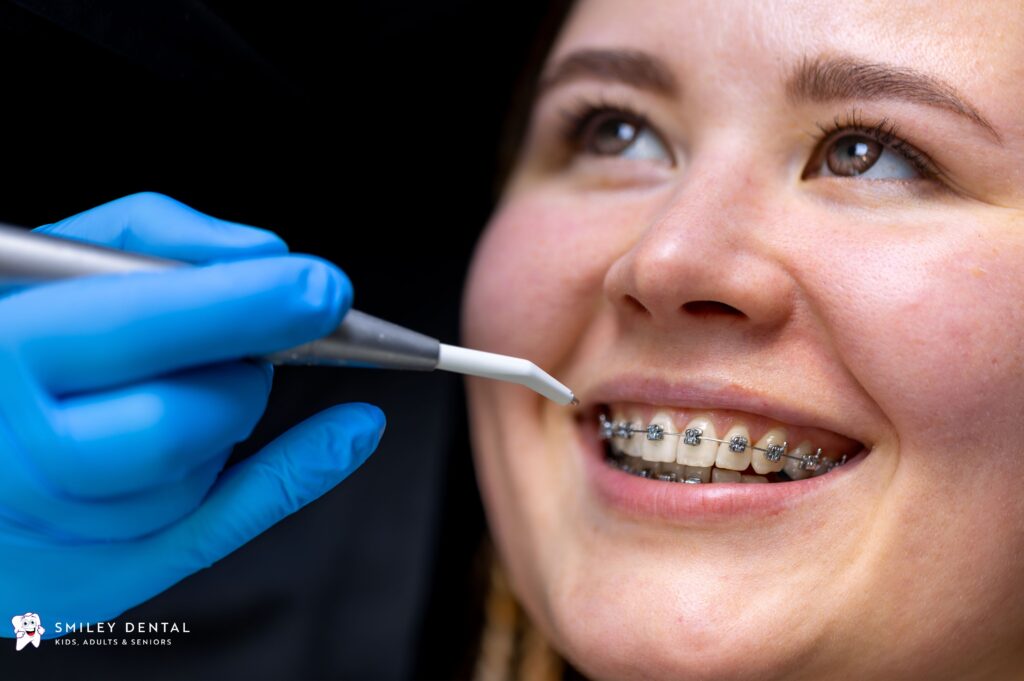
Traditional metal braces use small brackets bonded to each tooth and connected by a wire. The wire applies steady, continuous pressure that guides teeth into position, and your dentist adjusts it at regular visits.
Because braces are fixed to your teeth, they work around the clock without depending on you to remember anything. They handle everything from simple crowding to complex bite corrections, including significant overbites, which is why they remain a reliable choice for difficult cases.
Pros of Invisalign for Adults
Invisalign offers real advantages that many adults value:
- Nearly invisible, so most people will not notice you are in treatment.
- Removable for eating, brushing, and special occasions.
- Fewer diet restrictions, since you take the trays out to eat.
- More comfortable for many, with no metal brackets or wires to irritate your mouth.
- Easier oral hygiene, because you brush and floss normally.
Cons of Invisalign
Invisalign also has trade-offs worth understanding:
- Requires discipline, since the trays must be worn 20 to 22 hours a day to work.
- Not ideal for complex cases, such as severe crowding or significant bite problems.
- Can be lost or forgotten, especially when removed to eat.
- May need attachments, small tooth-colored bumps, or refinement trays to fine-tune results.
- Compliance-dependent, so results rely on you wearing them consistently.
Pros of Traditional Metal Braces
Braces have strengths that keep them a top choice, especially for certain cases:
- Highly effective for complex cases, including significant overbites and severe crowding.
- No compliance risk, since they are always working.
- Predictable for complex cases, often with a reliable treatment timeline.
- Widely familiar to insurers, with long-established orthodontic coverage.
Cons of Traditional Metal Braces
Braces come with their own downsides:
- More visible, with metal brackets and wires on your teeth.
- Food restrictions, since hard and sticky foods can damage them.
- Harder to clean around brackets and wires.
- Occasional discomfort from wires or brackets, eased with dental wax.
- Regular adjustment visits, typically every four to six weeks.
Invisalign vs Traditional Braces: Side by Side
Here is a detailed comparison of the two options:
| Feature | Invisalign | Traditional Braces |
|---|---|---|
| Procedure | Clear removable trays | Fixed brackets and wires |
| Cost (2026) | $3,500 to $8,000 | $3,000 to $7,000 |
| Appearance | Nearly invisible | Visible metal |
| Comfort | Smooth, mild pressure | Can irritate cheeks and lips |
| Treatment time | 6 to 18 months | 12 to 24 months |
| Compliance required | Yes, 20 to 22 hours daily | No, always working |
| Diet restrictions | None, trays come out | Avoid hard, sticky foods |
| Best for | Mild to moderate cases | Complex cases, all severities |
| Maintenance | Clean trays, brush normally | Clean around brackets |
| Visibility | Discreet | Noticeable |
Invisalign vs Braces: Which Is Faster?
Treatment time depends on your case complexity, not just the method. Neither option is automatically faster for everyone.
For mild to moderate cases, Invisalign can move a bit faster thanks to shorter intervals between tray changes, but only with consistent wear. For complex cases, braces often work faster and more predictably. Compliance is the biggest wildcard for Invisalign timelines. On average, Invisalign runs 6 to 18 months and braces 12 to 24 months.
Invisalign vs Braces for an Overbite
Overbites are among the most common bite issues, and the right treatment depends on severity. Mild to moderate overbites caused by tooth position can often be treated with Invisalign, usually with attachments and elastics.
Moderate to severe overbites, deep bites, or those caused by jaw differences are frequently better suited to braces, sometimes combined with other appliances. A general clinical guide is that smaller overbites tend to respond well to aligners, while larger ones benefit from the control of braces. Only a professional bite assessment can tell you which category you fall into, which is why a comprehensive dental exam comes first.
Considering Invisalign or Traditional Braces?
Schedule a comprehensive orthodontic evaluation to learn which option fits your bite and lifestyle, discuss treatment costs and financing, and understand your expected timeline. Call 857-888-8000 or request an appointment online. Keeping up with regular dental visits during treatment matters too.
Why Don’t Dentists Recommend Invisalign in Some Cases?
It is not a blanket no. Invisalign simply is not the right tool for every case or every person, and a good dentist will say so.
Complex bite problems and severe crowding often respond better to the mechanical control of braces. There are also compliance concerns for patients who may not wear the trays consistently. Cost and insurance differences can play a role too. The key point is that this is a case-by-case decision made after an exam, not a judgment about Invisalign itself.
Is $3,000 a Good Price for Invisalign?
It can be, depending on your case. Invisalign pricing varies widely by complexity, location, and provider, so there is no single right number.
For a shorter, simpler case treating minor crowding or a small gap, a lower price can be reasonable. For a complex case, a very low quote may reflect a limited treatment rather than a full one, so ask what is included. The number of aligners, treatment length, and any add-on procedures all affect the total. The best approach is to get a personalized quote after an evaluation, and to explore flexible financing that fits your budget.
Why Do People Quit Invisalign?
Invisalign asks for discipline that braces do not, and that is where people struggle. The most common reasons are all tied to compliance:
- Trouble wearing them enough, since 20 to 22 hours a day is a real commitment.
- Discomfort during tray changes for the first day or two of each new set.
- Forgetting or losing aligners, especially when eating out.
- Lifestyle conflicts, like frequent snacking or drinking coffee throughout the day.
None of this means Invisalign is a poor choice. It simply means compliance matters, and building good habits early makes all the difference.
Do Dentists Prefer Invisalign or Braces?
Most dentists do not have a blanket preference. They recommend whichever option gives you the best result for your individual case.
Case complexity, how likely you are to wear aligners consistently, and your goals all factor in. Some providers have more experience with one method, which can shape their guidance. The most reliable way to get a recommendation that fits you is a consultation, where your dentist evaluates your teeth and options.
How Dentists Decide Between Invisalign and Braces
Choosing the right treatment is a careful, personalized process. Your dentist typically considers:
- An oral examination of your teeth, gums, and overall oral health.
- Digital X-rays and scans to map your teeth and roots.
- A bite assessment to check for overbite, underbite, or crossbite.
- The severity of crowding, spacing, or misalignment.
- Your lifestyle and how likely consistent aligner wear would be.
- Budget and insurance, plus your treatment timeline preferences.
Caring for Invisalign and Braces
Good care protects your treatment and your teeth, and the routines differ by option.
For a deeper routine, see our guide on caring for your Invisalign clear braces.
Caring for Invisalign
- Clean your aligners daily, rinsing and gently brushing them, never with hot water.
- Brush and floss before reinserting so you do not trap food under the trays.
- Store trays in their case when they are out, to avoid loss or damage.
- Keep your check-ins so your dentist can track progress.
Caring for Braces
Brush after meals to clear food from brackets and wires.
Floss with threaders or picks designed for braces.
Avoid hard and sticky foods that can break brackets.
Attend adjustment visits to keep treatment on track.
Invisalign vs Braces for Adults: Lifestyle Comparison
Beyond the clinical details, here is how the two compare for everyday adult life:
| Consideration | Invisalign | Traditional Braces |
|---|---|---|
| Lifestyle fit | Flexible, removable | Fixed, always on |
| Case complexity handled | Mild to moderate | Mild to severe |
| Work and social | Discreet for meetings | More noticeable |
| Oral hygiene ease | Easy, brush normally | Requires extra care |
| Discomfort level | Mild, brief pressure | Bracket and wire friction |
| Insurance coverage | Often covered | Often covered |
| Long-term value | High for right cases | High for complex cases |
| Overall convenience | High with discipline | High, no decisions needed |
Are You a Good Candidate for Invisalign?
Invisalign may be a strong fit if several of these describe you:
- ✓You have mild to moderate crowding or spacing
- ✓You are willing to wear aligners 20 to 22 hours a day
- ✓You have good oral hygiene habits
- ✓You do not have severe bite issues
- ✓You are comfortable with a self-directed routine
- ✓You want a discreet option
- ✓You are committed to regular check-ins
Signs You May Need Traditional Braces Instead
Braces may be the better choice if any of these apply:
- ✓You have significant crowding or spacing
- ✓You have a moderate to severe overbite, underbite, or crossbite
- ✓You are concerned about wearing removable aligners consistently
- ✓You have complex tooth rotation needs
- ✓You prefer a fixed option with no daily decisions
Why Choose Smiley Dental Boston?
Our Boston dental office on American Legion Highway in Roslindale offers personalized orthodontic care for adults across Roslindale, Mattapan, Hyde Park, Dorchester, Jamaica Plain, West Roxbury, and Milton.
- Personalized treatment planning, matched to your bite, lifestyle, and goals.
- Experience with both options, Invisalign and traditional braces.
- Modern diagnostic technology, including digital scans and imaging.
- A comfortable patient experience with clear, straightforward guidance.
Learn more about cosmetic and smile services in Boston, read about top-rated cosmetic dentistry and Invisalign in Boston, or call 857-888-8000 to schedule a consultation.
The Bottom Line
Invisalign and traditional metal braces both straighten adult smiles effectively, just in different ways. Invisalign offers a discreet, removable, comfortable experience that suits many adults with mild to moderate needs, while braces provide proven, around-the-clock control that shines for complex cases and larger overbites. There is no single better option, only the one that best fits your case complexity, lifestyle, and budget.
The smartest first step is a professional orthodontic evaluation that weighs your teeth, your bite, and your goals. Correcting alignment and bite issues does more than improve your smile, it supports easier cleaning and better long-term dental health. If you are an adult in the Boston area weighing your options, contact Smiley Dental Boston to schedule a consultation and find out whether Invisalign or traditional braces is the best fit. Call 857-888-8000 or request an appointment online today.
Ready to straighten your smile?
Book an orthodontic consultation at Smiley Dental Boston to compare Invisalign and braces for your smile. Call 857-888-8000 or request an appointment online. Find us at 950 American Legion Hwy, Roslindale. New patients are always welcome.
Frequently Asked Questions
Neither is universally better. Invisalign is often ideal for mild to moderate cases and adults who want a discreet option and will wear it consistently. Braces are better for complex cases and those who prefer a fixed appliance. The right choice depends on your case, which an exam determines.
Yes. There is no age limit for straightening teeth, as long as your teeth and gums are healthy. Adults of all ages successfully use both Invisalign and braces. Treatment may take a little longer than for teens, but the results are just as rewarding.
Invisalign typically takes 6 to 18 months, while braces take 12 to 24 months, though both depend on your case. Invisalign can be faster for simple cases if worn consistently, while braces are often faster and more predictable for complex ones.
Both cause mild soreness as teeth move. Invisalign causes brief pressure for a day or two with each new tray, while braces can irritate the cheeks and lips and feel sore after adjustments. Most people find Invisalign a bit more comfortable, but neither is truly painful.
Often, yes, for mild to moderate overbites caused by tooth position, usually with attachments and elastics. Severe or jaw-related overbites are typically better treated with braces, sometimes with other appliances. A professional bite assessment determines what will work best for you.
Because it is not right for every case. Complex bite problems and severe crowding often respond better to braces, and Invisalign depends on wearing the trays consistently. It is a case-by-case decision made after an exam, not a rejection of Invisalign in general.
It can be for a simpler, shorter case. Invisalign pricing varies widely by complexity, location, and provider, so a low quote may reflect a limited treatment for a complex case. Ask what is included, and get a personalized quote after an evaluation.
Your treatment slows down or stalls, since the trays only move your teeth while you wear them. Consistent 20 to 22 hour daily wear keeps you on schedule. Under-wearing is the most common reason Invisalign timelines stretch out, so discipline is essential.
Sometimes. For complex cases, braces often work faster and more predictably. For mild to moderate cases, Invisalign can be just as fast or faster when worn consistently. Speed depends more on your specific case and compliance than on the method itself.
The only reliable way to know is through a personalized evaluation of your bone density, oral health, medical history, and lifestyle with a qualified dentist.