Gum disease is one of the most widespread – and most silently destructive – dental conditions affecting adults today. According to the Centers for Disease Control and Prevention, nearly half of American adults over the age of 30 show signs of periodontal disease. Yet millions of people go years without a proper diagnosis, simply because the early stages of the disease rarely cause pain. By the time symptoms become obvious, significant damage may already have occurred.
That’s the challenge modern dentistry has long faced: detecting gum disease early enough to treat it effectively. Artificial intelligence is now changing the equation. At Smiley Dental Roslindale, we believe in staying ahead of the curve – not just in patient care, but in the technology that supports it. Here’s a comprehensive look at how AI is reshaping periodontal diagnosis, treatment planning, and long-term gum health.
Understanding Gum Disease – And Why Early Detection Matters
Periodontal disease is an infection of the tissues that hold your teeth in place. It begins with the buildup of plaque – a sticky film of bacteria – along and beneath the gumline. When left untreated, this bacterial infection causes inflammation that gradually destroys the gum tissue and the bone that supports your teeth.
The disease progresses in stages, and each one carries different implications for treatment:
- Mild inflammation (gingivitis) – fully reversible with professional cleaning and improved home care.
- Mild-to-moderate attachment loss – treatable with deep cleaning (scaling and root planing), but requires ongoing maintenance.
- Severe attachment loss with tooth mobility – more complex therapy needed, possible tooth loss risk.
- Advanced disease with significant bone loss – may require surgical intervention and, in some cases, simple and surgical extractions to preserve surrounding teeth.
This is why early detection is not just a convenience – it’s the difference between a simple cleaning and major intervention. And this is precisely where AI is proving to be a game-changer.
The Limitations of Traditional Periodontal Screening
For decades, the standard approach to detecting gum disease has relied on manual clinical probing. A dentist or hygienist uses a small instrument to measure the depth of the spaces (pockets) between your teeth and gums. Healthy pockets are typically 1–3mm deep. Anything deeper may signal disease.
While this method is clinically sound, it has inherent limitations. Results can vary between providers and appointments. Subtle early-stage changes in bone density are difficult to detect on standard 2D X-rays. And the full pattern of bone loss across an entire mouth is hard to assess quickly without sophisticated tools.
The result? Many patients receive a diagnosis of gum disease only after it has progressed well beyond Stage 1 – when treatment becomes more intensive, more costly, and in severe cases, may involve procedures like simple and surgical extractions to protect the rest of the mouth.
How AI Is Revolutionizing Gum Disease Detection
Artificial intelligence brings a new layer of analytical power to periodontal care. Trained on millions of dental images and clinical datasets, AI systems can recognize patterns invisible to the human eye – and do so consistently, without fatigue or variation between appointments.
AI-powered radiographic analysis
One of AI’s most powerful applications in dentistry is the analysis of dental X-rays. Advanced algorithms can scan radiographs in seconds, detecting early signs of bone loss, changes in bone density, and other markers of periodontal disease that might be overlooked in a routine review. These tools don’t replace the dentist – they enhance the dentist’s ability to see more, catch more, and act faster.
At practices offering leading periodontal treatment, Boston patients rely on, AI imaging is rapidly becoming a standard part of the diagnostic workflow, giving clinicians a much richer picture of what’s happening beneath the gumline.
Personalized risk scoring and predictive analysis
AI tools don’t just analyze images – they synthesize data. By combining a patient’s X-rays with their health history, lifestyle factors, and clinical measurements, AI platforms can generate a personalized periodontal risk score. This means that rather than applying a blanket screening protocol to every patient, clinicians can identify who is at highest risk and prioritize their care accordingly.
Risk factors like diabetes, smoking, family history of gum disease, and certain medications all influence how quickly periodontal disease progresses. AI can weight these factors against clinical data to give a truly individualized assessment – something that would take a clinician significantly longer to calculate manually.
Real-time monitoring and longitudinal tracking
Another major advantage of AI in dental care is its ability to track change over time. By comparing current imaging with historical data, AI systems can flag subtle progression in bone loss or pocket depth that might otherwise be missed from one appointment to the next. This is particularly valuable for patients with a known history of gum disease who require ongoing monitoring as part of their maintenance plan.
AI and Smarter Treatment Planning at Smiley Dental
Detection is only the first step. What happens after a diagnosis is just as important – and AI is making treatment planning more precise and more transparent for patients.
Evidence-Based Treatment Recommendations
Once gum disease is diagnosed, AI platforms can recommend treatment pathways based on a patient’s specific clinical profile. For early-stage disease, this typically means non-surgical therapy – thorough scaling and root planing to remove calculus and bacteria from below the gumline, combined with improved home care and more frequent maintenance visits.
For more advanced cases, the AI may flag the need for surgical periodontal therapy, bone grafting procedures, or – when a tooth is beyond salvage – referral for simple and surgical extractions. Having AI support these recommendations means your clinician can walk you through the reasoning clearly, using data, imaging, and evidence-based guidelines rather than clinical intuition alone.
Better Patient Conversations
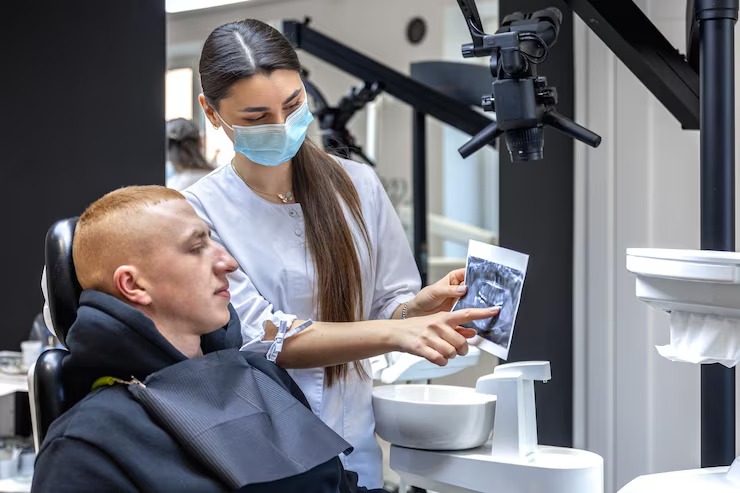
One of the most underappreciated benefits of AI in dental care is its impact on the patient experience. When a dentist can show you annotated X-rays with clearly marked areas of bone loss, or explain your personalized risk score in plain language, treatment decisions become much easier to understand and accept. Patients at Smiley Dental Boston aren’t just told they have a problem – they’re shown exactly what it looks like and what can be done about it.
This kind of transparency builds trust, improves treatment acceptance, and ultimately leads to better health outcomes because patients are more likely to follow through with recommended care.
When Gum Disease Leads to Tooth Extraction
Not every case of periodontal disease ends in tooth loss – in fact, most don’t when treated early. But in cases where the disease has progressed to Stage 3 or 4, some teeth may no longer be viable. Advanced bone loss, severe mobility, or persistent infection can make a tooth impossible to retain, even with aggressive treatment.
In these situations, simple and surgical extractions may be recommended. A simple extraction is performed on a tooth that is visible and accessible above the gumline. A surgical extraction is required when a tooth is impacted, broken below the gumline, or surrounded by compromised tissue that complicates removal. Both procedures are performed with care and precision at Smiley Dental Roslindale, with a focus on your comfort and on protecting the remaining teeth and bone structure.
Importantly, extraction is not the end of the story – it’s often the beginning of a restorative pathway that may include dental implants or other tooth replacement options to restore full function and aesthetics.
What to Expect at Your Periodontal Evaluation
If you’re coming in for a periodontal evaluation at Smiley Dental Boston, here’s what you can expect. Your hygienist or dentist will perform a thorough clinical examination, including probing measurements at multiple points around each tooth. Full-mouth X-rays will be taken and reviewed – potentially with AI-assisted analysis to identify areas of concern. Your health history, risk factors, and current symptoms will all be discussed.
From there, you’ll receive a clear diagnosis, a staged treatment plan, and honest guidance about what to expect at every step. Whether your needs are as simple as a thorough cleaning or as complex as advanced periodontal therapy, the goal is always the same: to protect your teeth, your gums, and your long-term oral health.
Frequently Asked Questions
What Are the Early Warning Signs of Gum Disease?
Early signs include bleeding when you brush or floss, red or swollen gums, persistent bad breath, and gum sensitivity. Many patients in the early stages have no symptoms at all, which is why regular professional screenings at Smiley Dental Roslindale are essential – not optional.
How Does AI Improve Gum Disease Diagnosis Compared to Traditional Methods?
AI-assisted imaging analyzes dental X-rays with a level of consistency and detail that complements clinical examination. It can detect subtle bone loss patterns, flag high-risk areas, and generate personalized risk assessments – all of which help your dentist make faster, more accurate decisions about your care.
What Does Periodontal Treatment Involve?
Periodontal treatment in Boston ranges from non-surgical options like deep cleaning (scaling and root planing) to surgical procedures for advanced disease. The right approach depends on the stage of your condition. Your dentist will recommend a treatment plan tailored to your specific clinical needs after a thorough evaluation.
Is Gum Disease Linked to Other Health Conditions?
Yes. Research has established clear links between periodontal disease and systemic conditions including heart disease, diabetes, respiratory illness, and adverse pregnancy outcomes. Treating gum disease isn’t just about your mouth – it’s an investment in your overall health.
How Often Should I Have a Periodontal Check-Up?
Patients with a history of gum disease or moderate-to-high risk factors are typically recommended to come in every 3–4 months for periodontal maintenance visits. For patients with no history of disease, an annual evaluation alongside regular cleanings is usually sufficient. Your care team at Smiley Dental Boston will advise the schedule that’s right for you.