
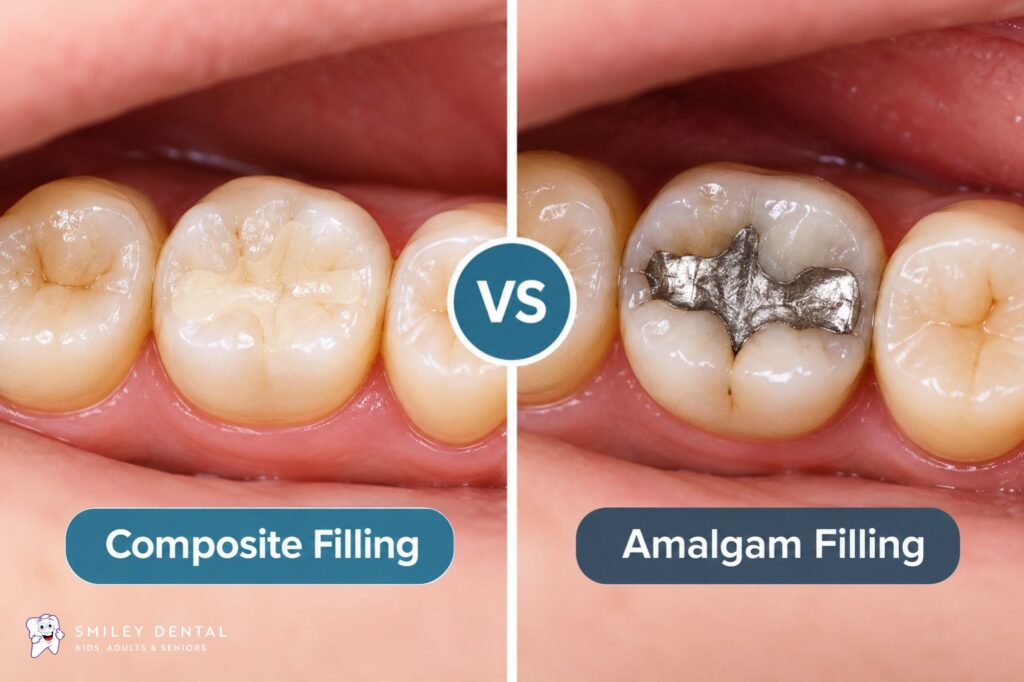
Neither composite nor amalgam is automatically the better filling for every tooth. Composite is a tooth-colored resin that bonds to tooth structure, while amalgam is a silver-colored metal restoration long valued for its strength. The right choice depends on where the tooth sits in your mouth, how large and deep the cavity is, how much healthy tooth structure remains, how hard you bite in that area, how visible the tooth is, and what your dentist finds during the examination.
The practical difference is simple. Composite is bonded into the prepared tooth and matched to your natural shade. Amalgam is packed into a prepared cavity and held mechanically rather than bonded in the same way. That single difference drives most of the other trade-offs patients ask about, which is why many practices, including our own tooth-colored fillings in Boston service, now place composite far more often than amalgam.
This guide covers what each material actually is, whether composite is genuinely healthier, which lasts longer, which looks more natural, what current federal guidance says about mercury-containing amalgam, how cost and insurance factor in, and the question that brings most people to this page: whether an existing silver filling needs to come out.
Quick Answer: Composite vs Amalgam Fillings: Which Is Better?
Both materials can be clinically appropriate. Composite fillings are tooth-colored and bond adhesively to the tooth, which makes them the usual choice for visible teeth and many moderate restorations. Amalgam has historically been used for its strength and durability in back teeth. The better option depends on the tooth, the size of the decay, bite forces, your preferences, and your dentist’s clinical judgment.
Composite vs Amalgam Fillings: What Is the Difference?
The two materials restore the same problem, a cavity caused by tooth decay, but they behave very differently inside the tooth.
What Are Composite Fillings?
Composite fillings are made from a tooth-colored resin containing fine glass or ceramic particles. The material is shade-matched to your enamel, placed in layers, and hardened with a curing light. Because composite bonds adhesively to enamel and dentin, it can often be placed with a more conservative preparation, meaning the dentist removes the decay and shapes the cavity without needing to cut extra undercuts purely to hold the filling in place.
Composite is the standard choice for front teeth and premolars, and it is widely used in molars as well, particularly for small to moderate restorations. It does have limits. Composite placement is technique-sensitive and requires good moisture control, so a deep restoration near the gumline in a difficult-to-isolate molar may not be an ideal composite case. Not every cavity is a composite cavity.
What Are Amalgam Fillings?
Dental amalgam is a silver-colored restorative material that has been used in dentistry for well over a century. It is a mixture of liquid elemental mercury with a powdered alloy of silver, tin and copper, and roughly half of the finished material is elemental mercury by weight. That composition is what gives amalgam its strength and also why it is now the subject of regulatory attention.
Amalgam has been used most often in molars, where chewing forces are highest and where its compressive strength and tolerance of a slightly damp field were genuine clinical advantages. It does not bond to the tooth the way composite does, so the cavity has to be shaped to retain it mechanically. It is also visibly grey, which is why the term “silver filling” persists even though silver is not the dominant ingredient.
What Is the Healthiest Tooth Filling to Get?
There is no single filling material that is healthiest for every patient or every tooth. Composite and amalgam can both be appropriate depending on the clinical situation. The best choice depends on the condition of the tooth, the size of the restoration, bite forces, how much sound tooth structure remains, your own preferences, and your dentist’s evaluation.
It helps to separate two different questions that patients often merge. The first is material preference, which covers appearance, what you have read, and what you would personally rather have in your mouth. The second is clinical suitability, which covers whether a given material can actually restore that specific tooth well and survive the forces acting on it.
A filling that looks perfect but fails in two years because it was the wrong material for a large load-bearing molar is not the healthier outcome. A restoration is “healthy” when it seals the tooth, restores function, protects remaining tooth structure, and lasts. Appearance is a legitimate part of the decision, but it is not the whole decision.
Are Composite Fillings Healthier Than Amalgam?
Composite fillings are not automatically healthier than amalgam for every patient. Composite offers a tooth-colored appearance and adhesive bonding to tooth structure. Amalgam has a long track record and can provide durable restorations in the right situations. What is true is that federal guidance now steers specific patient groups away from new amalgam, which matters for some people more than others.
The FDA has identified groups who may be more susceptible to potential adverse effects of mercury exposure and strongly encourages non-amalgam restorations such as composite resins and glass ionomers for those patients. Those groups include pregnant women and their developing fetuses, women planning to become pregnant, nursing women and their infants, children especially those under six, people with pre-existing neurological disease such as multiple sclerosis, Alzheimer’s disease or Parkinson’s disease, people with impaired kidney function, and people with a known sensitivity to mercury or the other metals in amalgam.
The picture for everyone else is more nuanced. The American Dental Association continues to support dental amalgam based on the dentist’s clinical judgment as a safe, durable and affordable option, and states that no properly designed scientific study has demonstrated that dental amalgam causes long-term health effects or disease.
So the accurate answer is not that one material is healthier in general. It is that composite is the recommended direction for specific higher-risk groups, and that for most other adults the material decision comes down to the tooth rather than to health risk. If you fall into one of the groups above, say so at your appointment.
Composite vs Amalgam Fillings: Side-by-Side Comparison
| Factor | Composite Fillings | Amalgam Fillings |
| Appearance | Tooth-colored | Silver-colored |
| Material | Composite resin | Dental amalgam (mercury, silver, tin, copper) |
| Natural appearance | High | Low |
| Bonding | Bonds adhesively to tooth structure | Retained mechanically, does not bond the same way |
| Common use | Front and back teeth depending on the case | Historically common for posterior teeth |
| Durability | Good durability when appropriately placed and sized | Known for strength, strong record in large posterior restorations |
| Tooth preparation | May allow more conservative preparation in suitable cases | Preparation shaped for mechanical retention |
| Moisture control | Technique-sensitive, needs a dry field | More tolerant of a difficult field |
| Cost | Varies by restoration size and insurance | Varies by restoration size and insurance |
| Insurance | Depends on the individual plan | Depends on the individual plan |
| Replacement | Based on clinical need | Existing amalgam does not automatically need removal |
| Best choice | Depends on tooth and patient | Depends on tooth and patient |
Which Filling Looks More Natural?
Composite fillings provide the more natural appearance. The resin is shade-matched to your existing tooth, so a well-placed composite in a front tooth or premolar is usually difficult to spot. Amalgam is grey and stays grey, and it can darken the surrounding tooth over many years, which makes it noticeable when you laugh or speak.
This matters most in the aesthetic zone: upper front teeth, canines, and first premolars that show in a wide smile. It matters much less on a second molar that almost nobody sees.
Appearance alone does not make composite clinically superior. A natural-looking restoration that is under-sized for the load it carries is still the wrong restoration. Appearance and clinical suitability are two separate questions, and a good treatment plan answers both.
Which Lasts Longer: Composite or Amalgam Fillings?
Amalgam has generally shown longer survival in back teeth in the research literature. A 2025 systematic review of eight studies found median survival for amalgam restorations in permanent posterior teeth exceeding 16 years compared with about 11 years for composite, with secondary decay the most common reason composites failed and fracture the most common reason amalgams were replaced. An earlier review summarised for the ADA similarly reported a shorter lifespan and higher secondary caries incidence for posterior composites, though the evidence was graded low quality.
Read that carefully, because it is easy to over-interpret. Those figures are averages across mixed study designs, much of the underlying data reflects older composite formulations and older bonding systems, and material science has moved since. More importantly, longevity in your mouth depends on tooth location, restoration size, bite force, whether you grind or clench, how well the field was isolated during placement, your oral hygiene, and whether you keep up with routine dental exams.
The longest-lasting material on paper is not automatically the right material for your tooth. If a molar has lost so much structure that neither filling material will hold up, the honest answer may be that the tooth needs a crown rather than a filling.
Is Composite Better for Front Teeth?
For visible teeth, composite is the usual recommendation. The shade can be matched to the surrounding enamel, the material bonds to tooth structure so the preparation can often stay conservative, and the result blends into the smile rather than announcing itself.
Front teeth also carry lower chewing loads than molars, which plays to composite’s strengths. That said, a very large fracture or extensive decay in a front tooth may call for a veneer or crown instead of a direct filling. Not every front-tooth problem is solved with composite.
Is Composite or Amalgam Better for Back Teeth?
Both materials can work in molars and premolars, and this is where the decision genuinely goes case by case. Factors your dentist weighs include the size and depth of the cavity, how much sound tooth structure is left after the decay is removed, the strength of your bite in that area, whether you clench or grind, how easy the tooth is to isolate from saliva, and whether the restoration extends below the gumline.
Small to moderate posterior cavities are routinely restored with composite today. Very large restorations in heavy-load molars are the situation where the strength argument for amalgam historically applied, and also the situation where a dentist may recommend an onlay or crown instead. The tooth, not the material preference, should drive that call.
Why Do Dentists No Longer Use Silver Fillings?
Many dentists now place tooth-colored composite far more often than amalgam, but it is not accurate to say that dentists universally no longer use amalgam. Usage has fallen sharply for several overlapping reasons: patient demand for natural-looking restorations, improvements in adhesive bonding, the ability to prepare teeth more conservatively, and a regulatory and environmental shift away from mercury-containing materials.
That policy shift is real and recent. In July 2026, HHS announced that CMS had notified every state Medicaid director urging them to phase out mercury-containing dental fillings by restricting or ending Medicaid coverage for amalgam procedure codes, referencing a February decision by the Indian Health Service to end amalgam use in its facilities by 2027 and the Minamata Convention commitment among parties to phase out dental amalgam by 2034. This is guidance encouraging state-level action rather than a nationwide ban on the material.
What that means for a patient is straightforward. New amalgam placement is becoming less common and will keep declining. It does not mean amalgam was retroactively unsafe, and it does not mean the fillings already in your mouth are a problem.
Are Amalgam Fillings Safe?
Dental amalgam contains elemental mercury and releases a small amount of mercury vapor. That is not disputed. What differs is how various bodies weigh that exposure.
The ADA’s position is that amalgam remains a safe, durable and affordable option when dentist and patient agree it is the best treatment, and that no properly designed study has shown it causes long-term health effects or disease. The FDA’s position is narrower and group-specific: it identifies populations who may face greater risk from mercury exposure and encourages non-amalgam materials for them.
Two practical points follow. First, if you belong to one of the higher-risk groups listed earlier, raise it before any new filling is placed so the material can be chosen accordingly. Second, current guidance does not ask people with sound, functioning amalgam fillings to have them removed. This page is general information, not a diagnosis or a treatment recommendation for your specific situation.
Should I Replace Amalgam Fillings With Composite?
An existing amalgam filling does not automatically need to be replaced simply because it is silver-colored or because you have read about mercury. Replacement may be appropriate if the filling is fractured, leaking, worn, associated with new decay at the margins, causing symptoms, or otherwise clinically indicated.
This is worth stressing because replacing a filling is a different procedure from placing a first one. Removing an intact amalgam means drilling out sound restoration material and, almost always, a little more tooth structure with it. Every replacement cycle leaves the tooth slightly weaker than before. A tooth that has been restored, re-restored and restored again eventually needs a crown, not another filling.
Factors your dentist will assess include the condition of the existing restoration, whether X-rays show recurrent decay underneath, marginal breakdown, cracks in the filling or the surrounding tooth, sensitivity or pain, the proportion of the tooth the restoration now occupies, and your own cosmetic priorities. A consultation as part of restorative dentistry in Boston can establish whether replacement is indicated or whether monitoring is the better call.
Do Old Silver Fillings Need to Be Replaced?
No. An intact amalgam filling that is sealing and functioning properly does not necessarily need removal just because it is old or grey. Age alone is not a failure criterion. A dentist can evaluate the restoration clinically and radiographically and decide whether replacement is warranted.
Evaluation is appropriate when you notice a cracked or broken filling, a rough or chipped edge, new sensitivity to cold, sweet or pressure, food packing around the filling, visible dark staining at the margin, or a piece that has come away. Those are reasons to have the tooth looked at. Colour, by itself, is not.
Are Composite Fillings More Expensive Than Amalgam?
Composite fillings are often priced higher than amalgam, but not always, and the gap varies. Fees depend on the size of the restoration, how many tooth surfaces are involved, which tooth is being treated, the complexity of the placement, and the individual practice.
It is worth separating the office fee from what you actually pay. Those are different numbers, and the second one depends entirely on your plan.
Does Insurance Cover Composite Fillings?
Coverage depends on your individual dental insurance plan and the specific restoration performed. Some plans reimburse composite and amalgam at the same rate, some apply an alternate benefit provision that reimburses a posterior composite at the amalgam rate and bills you the difference, and some treat front and back teeth differently. Deductibles, coinsurance and annual maximums all affect what you owe.
The reliable approach is verification before treatment rather than assumption after. You can review our accepted dental insurance plans and our team can check your specific benefits for the restoration being proposed.
Composite vs Amalgam Fillings in Boston, MA
Patients across Boston, including Roslindale, West Roxbury, Jamaica Plain and Hyde Park, ask this question regularly, and the honest answer is that the recommendation varies person to person. Two patients with cavities in the same tooth number can reasonably receive different materials depending on decay size, remaining tooth structure, bite, grinding habits and insurance.
With federal agencies encouraging states to move away from amalgam, the practical reality in Boston is that most new fillings placed today are tooth-colored. What has not changed is the need for an actual examination and X-rays before anyone can tell you what your specific tooth needs.
When Should You Have a Filling Evaluated?
Book an evaluation if you notice sensitivity to cold, heat, sweets or biting pressure, a rough or sharp edge on an existing filling, food consistently packing between teeth, visible darkening around a restoration’s margin, a chipped or missing piece of filling, or persistent discomfort in a restored tooth. Routine exams also catch marginal breakdown and recurrent decay before you feel anything, which is usually when treatment is simplest.
Frequently Asked Questions About Composite and Amalgam Fillings
No single material is healthiest for every patient or tooth. Composite and amalgam can both be appropriate. The best choice depends on the tooth’s condition, restoration size, bite forces, remaining tooth structure, patient preferences and the dentist’s evaluation.
Not universally. Composite is recommended for specific groups the FDA identifies as higher risk from mercury exposure, including pregnant women, young children and people with impaired kidney function. For most other adults, the choice is driven by the tooth rather than by health risk.
Many dentists now use composite far more often, but amalgam has not disappeared from dentistry entirely. The shift reflects patient demand for natural-looking restorations, improved bonding materials, and regulatory and environmental moves away from mercury-containing products.
Only when clinically indicated. Replacement makes sense if the filling is cracked, leaking, worn, associated with new decay or causing symptoms. Colour alone is not a reason, and each replacement removes a little more tooth structure.
Composite. The resin is shade-matched to your enamel, so it blends with the tooth. Amalgam is grey and remains visible, which matters most on teeth that show when you smile.
Research generally shows longer median survival for amalgam in back teeth. Real-world longevity depends on tooth location, restoration size, bite forces, grinding, oral hygiene and regular dental care.
The ADA continues to consider amalgam safe and durable when chosen by dentist and patient. The FDA encourages non-amalgam materials for specific higher-risk groups. Neither body recommends removing sound existing fillings without a clinical reason.
Often, but not always. Cost depends on restoration size, number of surfaces, tooth location, complexity, the practice and your insurance plan.
Both can be appropriate. Small to moderate posterior cavities are routinely restored with composite. Very large restorations in heavy-load molars may call for amalgam or, more often today, a crown or onlay.
No. An intact, well-sealed amalgam does not need removal just because it is old. Replacement depends on the condition of the restoration and the health of the underlying tooth.
Talk Through Your Filling Options in Boston
If you are deciding between composite and amalgam, a dental examination is what turns a general comparison into an actual recommendation for your tooth. Our team can assess the decay, review any existing restorations, explain what each material would mean in your case, and check your insurance benefits before treatment.
Schedule an appointment with Smiley Dental Boston to discuss your filling options with a dental professional.