
Quick Answer
A dental bridge usually costs less upfront, but a dental implant often delivers better long-term value. Implants typically last 20 years or more, help preserve jawbone, and leave the neighboring teeth untouched. Bridges commonly need replacing every 10 to 15 years and rely on filing down healthy teeth beside the gap. The best choice depends on your bone health, budget, and goals.
When a tooth is missing, most dentists offer these two options. Both work well, and the cheaper one on day one is not always cheaper over time.
What Are Dental Implants?
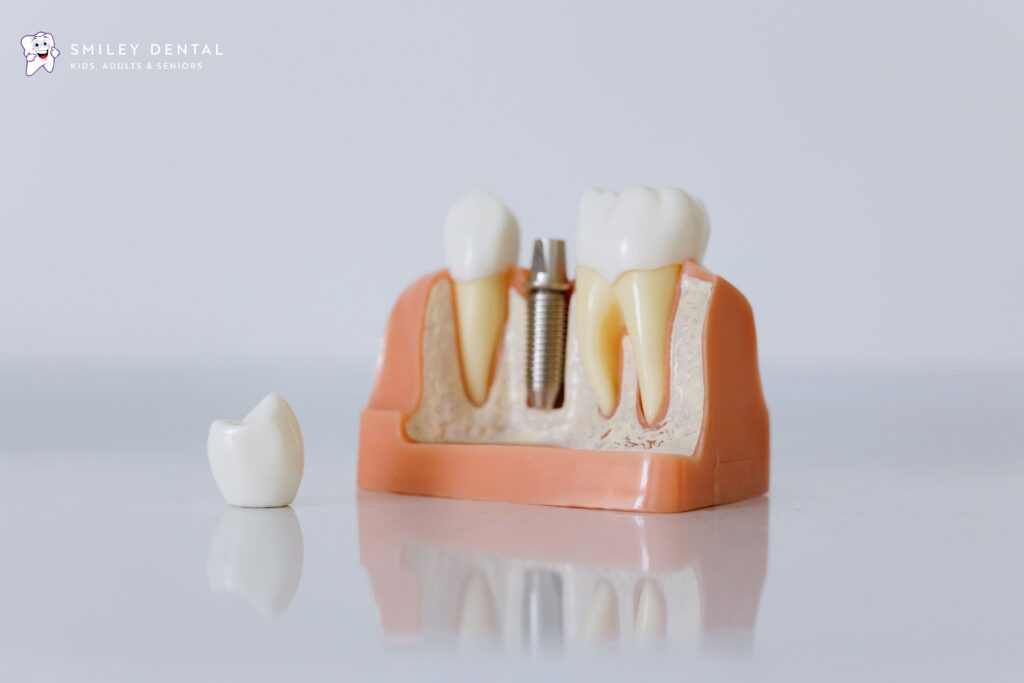
A dental implant replaces the root of a missing tooth. A small titanium post is placed into the jawbone, and over a few months the bone bonds to it, creating a foundation for a crown on top. Dental implants have three parts: the post, a connector called an abutment, and the visible crown.
Because the post sits in bone rather than on the gums, an implant is the only replacement that keeps stimulating the jaw the way a natural root does. That is why bone preservation comes up so often here.
What Are Dental Bridges?
A dental bridge fills the gap without surgery. A false tooth, called a pontic, is suspended between two crowns that fit over the teeth on either side of the space. Crowns and bridges are fixed in place, so nothing comes out at night.
The trade-off is that those neighboring teeth must be filed down to accept the crowns, even if perfectly healthy. A bridge for one missing tooth is called a three-unit bridge, since it covers three positions.
Dental Implants vs Bridges: What’s the Difference?
The differences that matter most to patients:
| Factor | Dental Implant | Dental Bridge |
|---|---|---|
| What it replaces | Root and crown | Crown only |
| Neighboring teeth | Left untouched | Filed down for crowns |
| Jawbone | Helps preserve it | Does not preserve it |
| Surgery | Minor surgery needed | No surgery |
| Treatment time | Several months | A few weeks |
| Typical lifespan | 20 years or more | 10 to 15 years |
| Cleaning | Brush and floss normally | Needs special flossing |
Cost Comparison: Which Option Is More Affordable?
On the first invoice, the bridge usually wins. Based on published national figures for 2026, a single implant including the post, abutment, and crown commonly runs about $3,000 to $6,000. A traditional three-unit bridge typically falls between $2,000 and $5,000, with the material driving much of that range.
Bridge prices vary by type. Metal alloy and porcelain-fused-to-metal sit at the lower end, all-ceramic and zirconia at the higher end, and a Maryland bridge, which bonds behind the neighboring teeth rather than crowning them, is usually cheapest.
These are national ranges, not quotes. Your actual cost depends on whether you need an extraction or a bone graft, which materials are used, imaging, sedation, and the complexity of your case. Insurance often covers part of the crown or bridge as major restorative work, commonly around 40 to 50 percent, though annual maximums and waiting periods apply and the implant post itself is frequently excluded. We verify your benefits, give you a written estimate before treatment, and offer flexible financing if you want to spread the cost.
Long-Term Value: Which Lasts Longer?
This is where the answer flips, and it is the part most people skip.
A bridge generally lasts 10 to 15 years before the cement fails, decay reaches an anchor tooth, or the crowns wear out. An implant post commonly lasts 20 to 25 years or more, often for life, with only the crown needing occasional replacement.
Why Durability and Maintenance Change the Math
Compare the two over 20 years rather than one appointment. A single implant may cost roughly what you paid at the start. A bridge, replaced once or possibly twice in that period, can total considerably more, with published estimates commonly putting the 20-year figure in the range of $4,000 to $10,000.
There is a second cost that never appears on an invoice. A bridge depends on two teeth that had to be filed down. If one later develops decay or fails, you lose more than the bridge, and the replacement gets more complex. An implant stands alone, so a problem stays contained.
Maintenance differs too. An implant is cleaned like a natural tooth. A bridge needs a floss threader to clean underneath the false tooth, and skipping that is a common reason bridges fail early.
Key Factors to Consider Before Choosing Implants or Bridges
Think through the health of your jawbone and gums, whether the teeth beside the gap are healthy or already crowned, how long you want the result to last, your general health and any conditions affecting healing, whether you smoke, how much time you can give to treatment, and what your insurance actually covers. These decide the answer more than the sticker price does.
Benefits and Drawbacks of Dental Implants
An honest look at both sides:
| Benefits | Drawbacks |
|---|---|
| Longest lasting option | Highest upfront cost |
| Preserves the jawbone | Requires minor surgery |
| Leaves neighboring teeth untouched | Takes several months to complete |
| Cleaned like a natural tooth | Needs enough healthy bone |
| Most natural feel and function | Not suitable for every patient |
Benefits and Drawbacks of Dental Bridges
Bridges remain a sensible choice for plenty of patients:
- Lower upfront cost and usually better insurance coverage.
- Faster treatment, finished in a few weeks rather than months.
- No surgery, which suits patients who cannot have a procedure or prefer to avoid one.
- Works without sufficient bone, so no graft is needed.
The drawbacks are real. Two healthy teeth are filed down permanently, the jawbone under the gap keeps shrinking, cleaning underneath takes effort, and the bridge will likely need replacing within 10 to 15 years.
Which Option Is Best for Different Patients?
There is no universal winner, only a better fit for your situation.
- An implant often suits you if you have healthy gums and enough bone, the teeth beside the gap are untouched, and you want the longest-lasting result.
- A bridge often suits you if the neighboring teeth already need crowns anyway, you have significant bone loss and want to avoid grafting, you need the gap closed quickly, or surgery is not advisable for medical reasons.
- Either may work if you are replacing a single back tooth and both options are clinically sound. Then it comes down to budget and how long you want it to last.
If the adjacent teeth already have large fillings or old crowns, a bridge looks considerably more sensible, since no healthy tooth structure is sacrificed.
- You have healthy gums, or gum disease that can be treated first
- You have enough jawbone, or are a candidate for a bone graft
- You are in reasonably good general health
- You do not smoke, or are willing to stop
- You can commit to several months of treatment
- You keep up with brushing, flossing, and regular checkups
Age is not on that list, because it is not a barrier. A dental exam with X-rays is what actually confirms whether implants are an option for you.
Why Choose Smiley Dental Boston for Dental Implants?
Our Roslindale office provides both options, which means the recommendation you get is based on your mouth rather than what we happen to offer.
- Surgically trained dentists, including an ICOI Fellow certified in placing implants and a dentist who completed Surgical Implantology at UCLA.
- Full restorative care, from single implants to full-arch and same-day options, plus crowns and bridges.
- Honest comparisons, including when a bridge is the better answer for you.
- Written estimates upfront, with benefits verified before treatment begins.
- In-network with many PPO plans and MassHealth, with financing through CareCredit, Cherry, and Sunbit.
We serve Roslindale, Mattapan, Hyde Park, Dorchester, Jamaica Plain, West Roxbury, and Milton from 950 American Legion Hwy. Learn more about our restorative dentistry services, or reach us through our contact page.
The Bottom Line
A bridge costs less today and is finished sooner. An implant costs more today, lasts far longer, protects the jawbone, and leaves your other teeth alone. Over 20 years rather than one invoice, the implant is frequently the better value, though not for everyone.
Bone health, the condition of the teeth beside the gap, your medical history, and your budget all shape the decision. Both are good treatments when matched to the right patient.
Not sure which is right for you?
Schedule a consultation with Smiley Dental Boston and we will examine the site, review your options honestly, and give you a written estimate for each. Call 857-888-8000 or book an appointment online. Find us at 950 American Legion Hwy, Roslindale. New patients are always welcome.
Frequently Asked Questions
Upfront, usually yes. Published 2026 ranges put a traditional bridge around $2,000 to $5,000 and a single implant around $3,000 to $6,000. Over 20 years the gap often closes or reverses, because bridges typically need replacing and implants usually do not.
An implant. The titanium post commonly lasts 20 to 25 years or more, often for life, though the crown may need replacing eventually. Bridges generally last 10 to 15 years before the cement, crowns, or an anchor tooth fails.
Partially, in many cases. Plans often contribute toward the crown as major restorative work, commonly around 40 to 50 percent, but frequently exclude the implant post. Annual maximums and waiting periods apply. We verify your specific benefits before treatment.
They require permanently filing down the two teeth beside the gap so crowns can fit over them. If those teeth already need crowns, little is lost. If they are perfectly healthy, that is a genuine trade-off worth weighing.
Often, yes, after a bone graft rebuilds the site. That adds a procedure and some healing time before the implant is placed. If grafting is not right for you, a bridge is usually the practical alternative.
A bridge is typically finished within a few weeks across two or three visits. An implant takes several months, since the bone needs time to bond to the post. You are not left with a visible gap during that time.
Not during placement, since the area is fully numbed, and sedation is available if you feel anxious. Most patients report mild discomfort afterward, and many find it easier than the extraction that came before it.
An implant-supported bridge is often the answer. Two implants can carry a bridge spanning several teeth, which costs less than placing an implant for every tooth while still preserving bone. A consultation determines whether it fits your case.