Quick Answer
Dental implants and dentures are both effective ways to replace missing teeth in seniors. Implants are anchored in the jawbone, so they feel and function like natural teeth, protect bone density, and rarely need replacing. Dentures sit on top of the gums, cost less upfront, and require no surgery, but they can shift while eating and need to be relined or replaced every several years. Neither option is automatically the right one. The best choice depends on your bone health, your medical history, your budget, and how you want to eat and live day to day.
Losing teeth becomes more common as we get older, and most patients are surprised to learn just how many options they actually have. This guide walks through how implants and dentures work, where each one wins and where it falls short, and how to figure out which path makes sense for you.
Why Missing Teeth Are So Common in Seniors
Tooth loss rarely comes from one single cause. A few of the biggest drivers we see in our patients include:
- Gum disease. Periodontal disease slowly breaks down the bone and tissue that hold teeth in place, and it is one of the leading reasons adults lose teeth.
- Tooth decay. Old fillings, cracked teeth, and cavities that go untreated for years often end in an extraction.
- Dental trauma. A fall or an accident can knock out or badly damage a tooth at any age.
- General aging changes. Enamel wears thin, saliva production can slow down, and many common medications affect oral health over time.
A missing tooth is never just a cosmetic issue. Gaps can make chewing certain foods difficult, affect how clearly you speak, limit what you can comfortably eat, and chip away at confidence when you smile. Replacing missing teeth early protects both your health and your quality of life.
What Are Dental Implants?
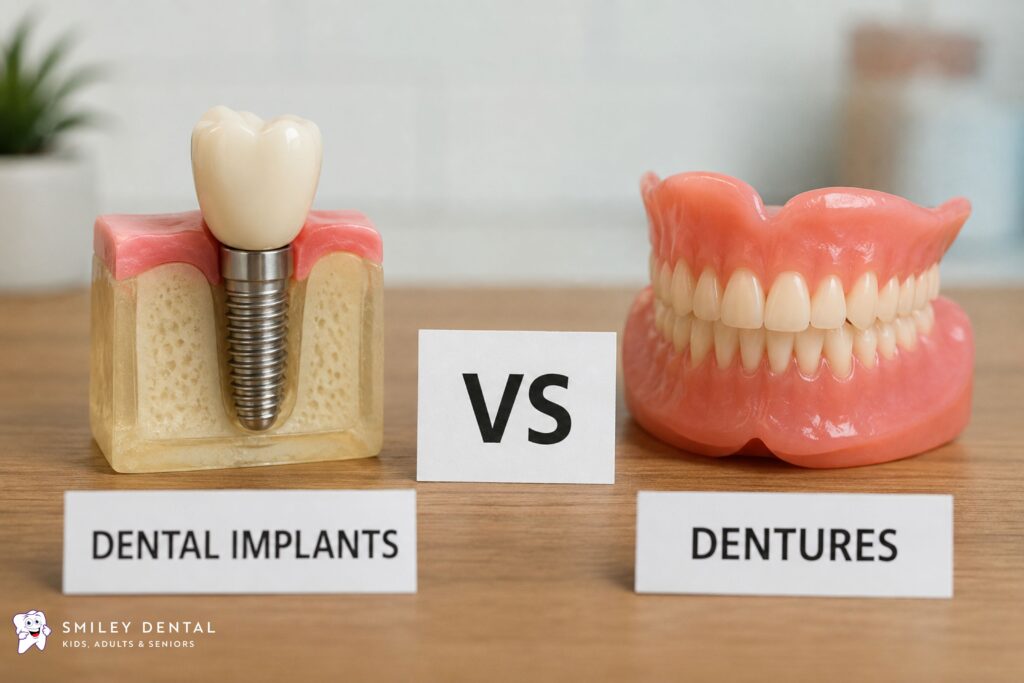
A dental implant replaces a missing tooth starting at the root. A small titanium post is placed into the jawbone, and over a few months, the bone fuses to it in a process called osseointegration. Once healed, a custom crown is attached on top, giving you a replacement tooth that looks, feels, and functions like your own.
Implants can replace a single tooth, several teeth, or, with implant supported dentures, a full arch. What sets implants apart is the way that titanium post keeps stimulating the jawbone, much like a natural root would. That stimulation is a big part of why implants help prevent the bone loss that often follows tooth loss.
What Are Dentures?
Dentures are removable appliances that replace some or all of the teeth in your upper or lower jaw. There are a few types to know:
- Full dentures replace an entire row of teeth.
- Partial dentures fill gaps when some natural teeth remain.
- Removable dentures come out for cleaning and overnight rest.
- Implant supported dentures snap onto a small number of implants for a more secure fit.
Dentures need daily care, including rinsing after meals, brushing to clear away plaque, and soaking overnight in a cleaning solution. With good care, most traditional dentures last around 5 to 7 years before the fit changes enough to need a reline or a full replacement, since the shape of your gums and jawbone keeps shifting over time.
Pros of Dental Implants for Seniors
- Look and feel like natural teeth
- Support strong, comfortable chewing
- Do not interfere with speech
- Last 20 years or longer, often a lifetime, with good care
- Help preserve jawbone density
- Stay fixed in place with no slipping
- Clean and care for just like a natural tooth
Cons of Dental Implants
- Higher upfront cost than dentures
- Require a surgical procedure
- Involve several months of healing before the final crown
- May need a bone graft if there is not enough jawbone
- Take longer overall to complete
- Not the right fit for every patient, particularly those with certain uncontrolled health conditions
Pros of Dentures
- Lower upfront cost
- Faster treatment with no healing period beforehand
- No surgery required
- Suitable for patients who are not candidates for implant surgery
- Can replace multiple teeth, including a full arch, in one appliance
- Easy for your dentist to adjust as your mouth changes
Cons of Dentures
- Can shift while chewing, especially with sticky foods
- May affect speech until you adjust to wearing them
- Often need adhesive to feel secure
- Do not prevent jawbone loss the way implants do
- Need periodic relining or replacement
- Provide less chewing strength than natural teeth or implants
Comparison Table: Dental Implants vs Dentures
| Category | Dental Implants | Dentures |
|---|---|---|
| Procedure | Surgical placement of a titanium post, then a crown | Custom fitted, removable appliance, no surgery |
| Cost | $3,000 to $6,000 for a single implant | $1,000 to $3,000 per arch for a traditional set |
| Appearance | Looks and feels like a natural tooth | Natural looking, though fit can be seen shifting slightly |
| Comfort | Very high once fully healed | Comfortable for most, with an adjustment period |
| Stability | Fixed in place, no movement | Can loosen or shift over time |
| Longevity | 20 years or more, often a lifetime | Typically 5 to 7 years before relining or replacement |
| Bone preservation | Stimulates and preserves the jawbone | Does not prevent jawbone loss |
| Maintenance | Brush and floss like a natural tooth | Daily cleaning plus overnight soaking |
| Healing time | Several months for full integration | Little to none |
| Eating ability | Full chewing strength for most foods | Reduced chewing efficiency for some foods |
| Speech | Minimal to no impact | May take time to adjust |
| Best for | Patients with enough bone and good general health who want a permanent solution | Patients who want a faster, more affordable option |
Is It Worth Getting Dental Implants at 70 Years Old?
Short answer: yes, for most healthy patients. Age by itself is not what determines whether implants will work. What actually matters is your overall health, your bone density, and how well your body heals.
Before recommending implants, we look closely at:
- Bone density in the jaw
- Existing conditions such as diabetes or osteoporosis, which can affect healing
- How well your body has healed from past procedures
For patients in good health with enough jawbone to support the post, implants often deliver years of reliable chewing, better nutrition, and a real boost in confidence. Plenty of our patients get implants well into their 70s and 80s.
What Is the Best Option for Missing Teeth Replacement?
There is no single answer that fits everyone. It depends on:
- A single missing tooth. One implant is usually the most conservative, longest lasting fix.
- Several missing teeth. Multiple implants or a partial denture can both make sense, depending on bone health and budget.
- A full arch. Full dentures, implant supported dentures, or full mouth reconstruction all come into play here.
- Budget. Dentures cost less at the start. Implants cost more upfront but often even out or come out ahead over 10 to 20 years, since dentures need relines and replacements along the way.
- Lifestyle. Patients who prioritize chewing strength and convenience often lean toward implants.
- Oral health goals. If preserving your jawbone and facial structure matters most to you, implants have a clear edge.
A personalized dental evaluation, including X-rays and a bone density check, is the only reliable way to know which option fits your mouth.
What Percentage of 70 Year Olds Wear Dentures?
Dentures remain common among older adults, though the exact percentage varies by country, region, and access to dental care. Implants have become far more common in recent years as a permanent alternative, but dentures are still widely used because they are affordable and work well for a broad range of patients. Rather than fixating on a national statistic, it is more useful to focus on what fits your own oral health and lifestyle. A quick exam can tell you exactly where you stand.
At What Age Should You Not Consider Dental Implants?
There is no upper age limit for dental implants. What we actually evaluate includes:
- Bone quality and quantity in the jaw
- Diabetes management, since uncontrolled blood sugar slows healing
- Smoking history, which lowers implant success rates
- Current medications, including certain osteoporosis drugs that can affect bone healing
- A full medical review before any treatment begins
We have placed implants successfully for patients in their 70s, 80s, and beyond. The decision comes down to a full health evaluation, not a birthday.
How Dentists Decide Between Dental Implants and Dentures
Choosing between implants and dentures is a team decision between you and your dentist. During a consultation, we typically review:
- A full oral exam
- Digital X-rays to assess your teeth and bone
- Bone density in the area of the missing teeth
- How many teeth need replacing
- Your medical history and current medications
- Your budget and financing preferences
- Your personal goals for permanence versus convenience
- Your lifestyle, diet, and daily care habits
That step by step review is what keeps the final treatment plan realistic, safe, and built around you.
Comparison Table: Dental Implants vs Dentures for Seniors
| Category | Dental Implants | Dentures |
|---|---|---|
| Lifestyle fit | Best for active seniors who want normal chewing function | Convenient for those who prefer a simpler, removable option |
| Oral health | Supports long term jawbone and gum health | Requires monitoring for irritation and bone changes |
| Treatment time | Several months from start to finish | Often completed within a few weeks |
| Surgery required | Yes | No |
| Daily cleaning | Brush and floss as usual | Remove, clean, and soak every day |
| Replacement frequency | Rarely needed with proper care | Every 5 to 7 years on average |
| Long term value | Higher upfront cost, strong value over time | Lower upfront cost, ongoing costs add up |
| Insurance coverage | Coverage varies and often excludes the implant post itself | Frequently covered more comprehensively |
| Overall convenience | Fixed in place, nothing to remove | Removable and simple to manage day to day |
Caring for Dental Implants and Dentures
Dental implants are cared for much like your natural teeth:
- Brush twice daily
- Floss around the crown
- Keep up with professional cleanings
- Attend regular dental exams to check the implant and surrounding gum tissue
Dentures need a slightly different routine:
Clean daily with a denture brush and the right cleanser
Soak overnight in an appropriate solution
Store them properly so they do not warp
Schedule adjustments as the fit changes
Keep up with dental visits even without natural teeth, so we can check your gums and jaw
Checklist: Are You a Good Candidate for Dental Implants?
- Good overall health
- Healthy gums, or gum disease that can be treated first
- Enough jawbone to support an implant, or candidacy for a bone graft
- One or more missing teeth
- Non smoker, or willing to quit before treatment
- Good daily oral hygiene habits
- Willingness to commit to follow up appointments and healing time
- Interest in a long term, permanent solution
Checklist: Signs It’s Time to Replace Missing Teeth
- Difficulty chewing certain foods
- One or more missing teeth
- Loose or shifting dentures
- Frequent denture discomfort
- Noticeable bone loss in the jaw
- Changes in facial appearance
- Trouble speaking clearly
- Reduced confidence when you smile
Considering Dental Implants or Dentures?
Schedule a comprehensive dental evaluation. Ask about your personal tooth replacement options. Find out whether implants or dentures fit your needs. Talk through treatment costs and financing. Get a clear picture of your expected timeline. Keep up with regular dental visits for long term oral health.
Why Choose Smiley Dental Boston?
Deciding between implants and dentures is personal, and having an experienced team walk you through it makes the process much easier. At Smiley Dental Boston, treatment planning starts with a complete picture of your oral health, backed by modern diagnostic technology and a calm, patient centered approach. Whether you need a single implant, a full set of dentures, or a more involved full mouth reconstruction, our goal stays the same: restore your function, comfort, and confidence for the long run. You can read more about our approach on The Smiley Difference page or meet the team on our Meet Our Doctors page.
The Bottom Line
Implants cost more today but tend to last far longer, protect your jawbone, and function closest to natural teeth. Dentures cost less at the start, involve no surgery, and get you a full smile faster. Neither one is the automatic right answer. Your bone health, medical history, budget, and daily habits all shape which option fits you best, and both are excellent treatments when they are matched to the right patient.
Replacing missing teeth sooner rather than later protects your long term oral health and your quality of life.
Ready to find the right fit for your smile?
If you are ready to explore your options, contact Smiley Dental Boston to schedule a consultation and get a clear, personalized recommendation on whether implants or dentures make the most sense for your smile. Contact us today.
Frequently Asked Questions
Neither is universally better. Implants offer more stability and a longer lifespan. Dentures offer a faster, more affordable path to a full smile. The right choice depends on your bone health, budget, and personal goals.
Yes. Age is not a barrier on its own. What matters is bone density, overall health, and how well you heal, all of which we check during a dental exam.
With proper care, implants commonly last 20 years or more, and many patients keep them for life. The crown on top may need replacing eventually due to normal wear.
Most dentures need relining, adjusting, or full replacement every 5 to 7 years as your gums and jawbone naturally change shape.
Most patients report only mild discomfort afterward, usually managed with over the counter pain relief. Many say the recovery is easier than they expected.
Poorly fitted or older dentures can irritate the gums, cause sore spots, or contribute to bone loss over time. Regular adjustments and checkups help prevent this.
Implants generally look the most natural since they replace both the root and the crown, but a well made denture can also look refined and natural.
Yes. Implant supported dentures use a small number of strategically placed implants to support a full arch, offering more stability than traditional dentures.
For many patients, yes. They combine the affordability of dentures with the added stability of implants, making them a popular middle ground option.
The only reliable way to know is through a personalized evaluation of your bone density, oral health, medical history, and lifestyle with a qualified dentist.